

Đề thi thử Tốt nghiệp THPT 2025-2026 môn Tiếng Anh Sở GD&ĐT Hà Tĩnh (Kèm đáp án chi tiết)
 56 trang
31/05/2026
2640
56 trang
31/05/2026
2640
Bạn đang xem 30 trang mẫu của tài liệu "Đề thi thử Tốt nghiệp THPT 2025-2026 môn Tiếng Anh Sở GD&ĐT Hà Tĩnh (Kèm đáp án chi tiết)", để tải tài liệu gốc về máy hãy click vào nút Download ở trên.
Tóm tắt nội dung tài liệu: Đề thi thử Tốt nghiệp THPT 2025-2026 môn Tiếng Anh Sở GD&ĐT Hà Tĩnh (Kèm đáp án chi tiết)
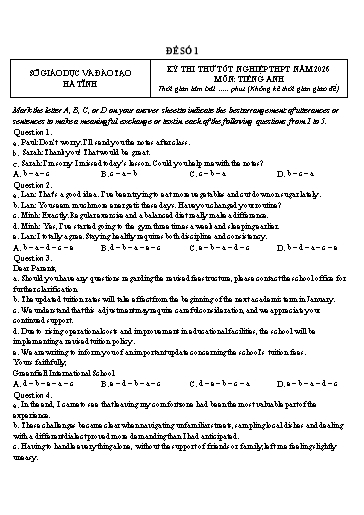
 Các đáp án khác nói về tốc độ xây dựng, dân số, công nghệ kiến trúc; không phù hợp bằng.
Question 10. Đáp án: D
Cấu trúc câu:
“There is evidence that much of the continuing resistance ... _____ and the prevailing mindset ...”
Chủ ngữ là much of the continuing resistance, cần động từ chính.
D. can be attributed to the high cost of maintenance: đúng cấu trúc: “có thể được quy cho chi phí bảo
trì cao...”
A thiếu động từ chính.
B có “which” làm mệnh đề quan hệ, khiến câu thiếu động từ chính.
C sai cấu trúc: phải là “is attributed to”, không dùng “is greatly attributing to”.
Question 11. Đáp án: B
“a tranquil _____ where you can enjoy a slower pace of life...”
getaway: kì nghỉ, nơi nghỉ dưỡng, chuyến đi tránh xa ồn ào.
itinerary: lịch trình.
departure: sự khởi hành.
heritage: di sản.
Câu nói về một nơi/chuyến đi yên bình nên chọn getaway.
Question 12. Đáp án: B
Cần cụm danh từ đúng trật tự tính từ + danh từ:
cultural experience: một trải nghiệm văn hóa đặc biệt.
Các phương án khác sai trật tự từ.
Đáp án: B.
Question 13. Đáp án: C
Câu gốc:
“learn _____ traditional farming techniques”
Sau chỗ trống là danh từ số nhiều techniques, cần tính từ hạn định.
other traditional farming techniques: những kĩ thuật canh tác truyền thống khác.
another dùng với danh từ số ít.
others là đại từ, không đứng trước danh từ.
each không hợp nghĩa ở đây.
Đáp án: C.
Question 14. Đáp án: A
Câu gốc:
“_____ our tour groups are very small, you will receive personalized attention...”
Quan hệ nguyên nhân – kết quả: vì nhóm nhỏ nên du khách được quan tâm cá nhân.
Because: vì.
Despite + danh từ/V-ing, không đi với mệnh đề đầy đủ như vậy.
But không đứng đầu mệnh đề phụ kiểu này.
Though mang nghĩa mặc dù, sai nghĩa.
Đáp án: A. Question 15. Đáp án: C
Cụm đúng là:
get on the boat = lên thuyền.
Câu:
“before getting on the wooden boats”
Đáp án: C.
Question 16. Đáp án: C
Sau can dùng động từ nguyên mẫu không “to”.
“so we can replace it for you”
can replace: đúng.
can replacing, can to replace, can replaced: sai.
Đáp án: C.
Question 17. Đáp án: A
Từ superficial nghĩa là hời hợt, nông cạn.
shallow: nông cạn, hời hợt.
complex: phức tạp.
deep: sâu sắc.
meaningful: có ý nghĩa.
Đáp án: A.
Question 18. Đáp án: C
Từ flattened trong bài nói về việc âm nhạc bị làm cho đồng nhất, mất sự đa dạng.
Từ trái nghĩa phù hợp là:
diversified: được đa dạng hóa.
Các từ compressed, simplified, leveled đều gần nghĩa với “flattened” hơn là trái nghĩa.
Đáp án: C.
Question 19. Đáp án: A
Toàn bài nói rằng nhạc số giúp âm nhạc phổ biến rộng rãi, nhưng thuật toán và nền tảng streaming đang
làm giảm chiều sâu văn hóa, tính nghệ thuật và sự kết nối của con người với âm nhạc.
A tóm tắt đầy đủ nhất cả hai mặt: khả năng tiếp cận toàn cầu và rủi ro làm giảm chiều sâu văn hóa, kết
nối con người.
B chỉ nói về thuật toán phân loại nhạc, quá hẹp.
C chỉ tập trung vào bất bình đẳng tài chính, chưa đủ.
D chỉ nói về “skip-rate”, cũng quá hẹp.
Đáp án: A.
Question 20. Đáp án: B
Câu hỏi hỏi điều NOT true.
A đúng: “skip-rate” khiến nghệ sĩ ưu tiên thu hút nhanh hơn là độ phức tạp.
B sai: bài nói mô hình doanh thu của nền tảng lớn tạo bất bình đẳng, không công bằng cho nghệ sĩ độc
lập.
C đúng: thuật toán thường bỏ qua bối cảnh lịch sử, văn hóa của bài hát. D đúng: streaming biến âm nhạc từ đối tượng nghệ thuật thành dịch vụ nền.
Đáp án: B.
Question 21. Đáp án: B
Có thể suy ra rằng việc phụ thuộc vào thuật toán sẽ làm âm nhạc bị chuẩn hóa, các tiếng nói nghệ thuật
độc đáo và độc lập khó được lắng nghe.
B đúng với ý “musical subcultures is being flattened” và nghệ sĩ độc lập bị thiệt.
A sai vì bài không nói quay lại bán đĩa vật lí là giải pháp.
C sai vì không phải nhạc phức tạp không tương thích về kĩ thuật.
D sai vì không nói nhà soạn nhạc cố ý viết nhạc cho đi lại/việc nhà.
Đáp án: B.
Question 22. Đáp án: A
Câu cần chèn:
“As a result, songs requiring deep attention are systematically marginalized.”
Vị trí phù hợp nhất là [III], trước đoạn nói về “skip-rate”.
Lí do:
Đoạn trước nói thuật toán làm mất bối cảnh, làm âm nhạc trở nên hời hợt.
Câu được chèn nêu kết quả: những bài cần nghe sâu bị gạt ra ngoài.
Sau đó, đoạn tiếp theo giải thích một nguyên nhân chính: “skip-rate”.
Đáp án: A. [III].
Question 23. Đáp án: D
Câu trong bài:
“In the past, listening to an album was often a special ritual; today, it is frequently reduced to a stream of
data...”
Từ it thay cho listening to an album.
Đáp án: D.
Question 24. Đáp án: C
Đoạn 4 nói về:
mô hình kiếm tiền của các nền tảng lớn thưởng nhiều cho siêu sao toàn cầu;
nghệ sĩ độc lập kiếm được rất ít;
thuật toán làm mất sự kiểm soát của con người trong việc khám phá âm nhạc;
mất kết nối giữa tầm nhìn nghệ thuật và tâm hồn.
Vì vậy trọng tâm là:
financial inequality and the loss of genuine human connection in music discovery
Đáp án: C.
Question 25. Đáp án: C
Câu gạch chân:
“The true cost of this algorithmic convenience may be the loss of our ability to listen deeply.”
Nghĩa là: sự tiện lợi của thuật toán có thể khiến con người mất khả năng nghe nhạc một cách tập trung và
hiểu chiều sâu của nó.
C diễn đạt đúng nhất. A sai vì không cần bác bỏ hoàn toàn dịch vụ hiện đại.
B sai vì nói thuật toán là công cụ duy nhất, trái ý bài.
D nói về thành công tài chính, không đúng trọng tâm.
Đáp án: C.
Question 26. Đáp án: D
Bài viết nêu rõ:
“the money paid by a fan of an independent artist often goes into a large pool that rewards the most-
played stars.”
Nghĩa là tiền của người nghe nghệ sĩ nhỏ/độc lập thường bị đưa vào quỹ chung để trả cho các siêu sao
được nghe nhiều nhất.
Đáp án: D.
Question 27. Đáp án: B
Câu trong bài:
“Gross Domestic Product (GDP) has been the paramount metric... Created in the 1930s to track industrial
production, it was never designed...”
Từ It thay cho Gross Domestic Product.
Đáp án: B.
Question 28. Đáp án: A
Đoạn 2 nhắc đến các trọng tâm của “Well-being Economy”:
dignified life;
healthy planet;
mental health;
housing quality.
Không nhắc industrial production như một trọng tâm của Well-being Economy.
Đáp án: A.
Question 29. Đáp án: B
penalizes = phạt, gây bất lợi, trừ điểm.
Từ trái nghĩa là:
rewards = thưởng.
Đáp án: B.
Question 30. Đáp án: A
A đúng: bài nói Iceland, Scotland, New Zealand đã đưa các nguyên tắc này vào ngân sách quốc gia,
chuyển trọng tâm từ tăng trưởng tài chính sang các chỉ số hạnh phúc.
B sai: GDP không tính đến cạn kiệt tài nguyên.
C sai: HPI không kết hợp trực tiếp tăng trưởng tài chính liên tục.
D sai: chỉ số thay thế như HPI bị phê bình vì yếu tố chủ quan, không phải toàn bộ Well-being Economy
“fundamentally unreliable”.
Đáp án: A.
Question 31. Đáp án: B
inevitable = không thể tránh khỏi, tất yếu. unavoidable = không thể tránh khỏi.
Đáp án: B.
Question 32. Đáp án: C
Đoạn 1 nói GDP được tạo ra vào thập niên 1930 để theo dõi sản xuất công nghiệp.
Đây là mục đích ban đầu và bối cảnh lịch sử của GDP.
Đáp án: C. Paragraph 1.
Question 33. Đáp án: C
Đoạn 3 nói về Happy Planet Index và các phê bình:
phụ thuộc nhiều vào tự báo cáo chủ quan;
có thể bị ảnh hưởng bởi thiên kiến văn hóa;
chưa ổn định để so sánh quốc tế.
Đáp án: C. Paragraph 3.
Question 34. Đáp án: C
Câu gạch chân:
“the traditional obsession with ‘growth at any cost’ is being replaced by a more balanced approach.”
Nghĩa là: tư duy truyền thống chỉ chăm chăm tăng trưởng kinh tế bằng mọi giá đang dần nhường chỗ cho
cách tiếp cận cân bằng hơn.
C diễn đạt đúng nhất.
A sai vì vẫn tiếp tục theo đuổi sản xuất công nghiệp cao.
B sai vì nói cách tiếp cận cân bằng kém quan trọng hơn lợi ích tài chính.
D sai vì không phải bỏ qua hoàn toàn tăng trưởng kinh tế.
Đáp án: C.
Question 35. Đáp án: B
Câu gốc:
“This trend has become _____ attractive...”
Cần trạng từ bổ nghĩa cho tính từ attractive.
remarkably attractive = hấp dẫn một cách đáng kể.
remarkable là tính từ, không bổ nghĩa trực tiếp cho tính từ khác trong cấu trúc này.
remarked, remark sai loại từ.
Đáp án: B.
Question 36. Đáp án: C
Cụm đúng:
a significant amount of attention = một lượng đáng kể sự chú ý.
attention là danh từ không đếm được nên dùng amount.
number dùng với danh từ đếm được số nhiều.
few, many dùng với danh từ đếm được số nhiều.
Đáp án: C.
Question 37. Đáp án: A
Câu gốc:
“you should _____ old habits and learn how to live in harmony with nature.” give up old habits = từ bỏ thói quen cũ.
take off = cất cánh/cởi ra.
get on = lên xe/tàu/thuyền hoặc tiếp tục.
look for = tìm kiếm.
Đáp án: A.
Question 38. Đáp án: C
Cụm cố định:
in many parts of the world = ở nhiều nơi trên thế giới.
Đáp án: C.
Question 39. Đáp án: B
Câu gốc:
“various projects _____ opportunities to plant trees are now welcoming international volunteers.”
Cần cụm phân từ hiện tại bổ nghĩa cho projects:
projects providing opportunities = các dự án cung cấp cơ hội.
providing: đúng.
to provide không hợp cấu trúc ở đây.
provided mang nghĩa bị động, sai nghĩa.
provide là động từ chia số nhiều, nhưng câu đã có động từ chính là are welcoming.
Đáp án: B.
Question 40. Đáp án: B
Câu gốc:
“develop a more _____ awareness of the delicate balance between humans and the Earth.”
holistic awareness = nhận thức toàn diện.
mutual = lẫn nhau.
tangible = hữu hình, có thể chạm được.
intrinsic = nội tại, thuộc bản chất.
Ngữ cảnh nói về nhận thức toàn diện về mối cân bằng giữa con người và Trái Đất.
Đáp án: B. ĐỀ SỐ 3
 KỲ THI THỬ TỐT NGHIỆP THPT NĂM 2026
 SỞ GIÁO DỤC VÀ ĐÀO TẠO
 MÔN: TIẾNG ANH
 HÀ TĨNH
 Thời gian làm bài: ..... phút (Không kể thời gian giao đề)
Read the following advertisement and mark the letter A, B, C, or D on your answer sheet to indicate
the option that best fits each of the numbered blanks from 1 to 6.
 Edinburgh Science Festival
 The Edinburgh Science Festival is an annual event (1) celebrates scientific discovery and
innovation. Held each spring, the festival offers numerous exhibitions, workshops and interactive
activities designed to (2) interest among people of all ages. Visitors are encouraged to take part in
hands-on experiments and discussions (3) by scientists and researchers. Although
participants may have little scientific background, the activities are designed to be accessible and
engaging.
 The festival also highlights the importance of scientific (4) in modern society, especially in
addressing global challenges. Many events rely on collaboration between universities, schools and
research organisations. (5) the festival to receive greater support from schools and local communities, it
would have an even wider impact. Some schools already organise regular science-related activities for
young people, and (6) schools may follow if more support is available.
(Adapted from https://www.earthday.org)
Question 1.
A. who B. which C. whose D. whom
Question 2.
A. create B. reduce C. ignore D. cancel
Question 3:
A. led B. are led C. lead D. leading
Question 4.
A. illiteracy B. literately C. literate D. literacy
Question 5.
A. Should B. Unless C. Had D. Were
Question 6.
A. the other B. other C. others D. another
Read the following passage and mark the letter A, B, C or D on your answer sheet to indicate the best
answer to each of the following questions from 7 to 14.
 As smartphones increasingly dominate online activity, improving mobile usability has become a strategic priority for digital designers. Compared with desktop interfaces, mobile environments present
constraints due to limited screen space and touch-based interaction. These conditions require layouts that
minimise distraction, highlight essential functions and help users complete tasks efficiently without
excessive cognitive effort.
 A common problem in mobile interface design is visual clutter. When too many buttons, images or
text blocks compete for attention, users may struggle to navigate effectively or interpret information
accurately. Establishing a clear visual hierarchy, maintaining consistent design patterns and ensuring
readable typography allow users to process content more smoothly. Removing redundant elements and
simplifying structures can significantly enhance clarity while preserving functional balance and interface
consistency.
 Effective navigation is essential for maintaining usability across mobile platforms. Since small
screens cannot accommodate complex menu systems, designers must adopt simplified and logically
organised structures. Features such as compact icons, bottom navigation bars and gesture-based
commands are widely used to facilitate quicker interaction. However, these solutions must be carefully
designed, as poorly labelled or hidden functions may confuse users and reduce overall satisfaction.
 Performance and responsiveness also shape user experience. Mobile users often access
information in short sessions and expect immediate results. When a page loads slowly or relies heavily on
visual effects, users may abandon it more quickly, weakening long-term engagement. Technical
optimisation, including image compression, efficient coding and adaptive design, supports smoother
performance across devices and varying network conditions.
 Finally, user testing remains crucial in mobile design. By observing real usage patterns, designers
can identify obstacles that theoretical assumptions overlook. They can then adjust layouts and refine
navigation flows to align better with user
expectations. In a competitive digital marketplace, usability functions not merely as an
enhancement but as a fundamental requirement for sustained growth.
(Adapted from https://consumersearch.com)
Question 7. Which of the following is NOT mentioned as a factor affecting mobile usability
A. Hardware storage capacity
B. Performance and responsiveness
C. Touch-based interaction
D. Limited screen space
Question 8. The word constraints in paragraph 1 can be best replaced by .
A. innovations B. advantages C. adjustments D. limitations
Question 9. The word redundant in paragraph 1 can be best replaced by .
A. unnecessary B. excessive C. essential D. innovative
Question 10. The word it in paragraph 4 refers to . A. a technical optimisation B. a long-term engagement
C. a page D. a user behaviour
Question 11. Which of the following best paraphrases the underlined sentence in paragraph 5?
A. In competitive digital markets, platform success often results from marketing instead of
improvements.
B. In competitive digital markets, usability has become essential rather than simply an additional
improvement.
C. In competitive digital markets, sustained growth depends mainly on innovative visual design
strategies.
D. In competitive digital markets, usability can enhance platforms but is not always necessary for growth.
Question 12. Which of the following is TRUE according to the passage?
A. Complex menu systems are suitable for small mobile screens.
B. Visual effects always strengthen long-term engagement.
C. User testing guarantees error-free interface design.
D. Hidden or unclear navigation elements may decrease user satisfaction.
Question 13.Which paragraph discusses the importance of reducing unnecessary design elements
A. Paragraph 4 B. Paragraph 3 C. Paragraph 2 D. Paragraph 1
Question 14. Which paragraph refers to technical strategies for improving system performance?
A. Paragraph 5 B. Paragraph 3 C. Paragraph 2 D. Paragraph 4
Mark the letter A, B, C, or D on your answer sheet to indicate the best arrangement of utterances or
sentences to make a meaningful exchange or text in each of the following questions from 15 to 19.
Question 15.
a. Paul: Don’t worry. I’ll send you the notes after class
b. Sarah: Thank you! That would be great.
c. Sarah: I’m sorry I missed today’s lesson. Could you help me with the notes?
A. b-a-c B. c-a-b C. b-c-a D. c-b-a
Question 16.
a. Lan: That's a good idea. I've been trying to eat more vegetables and cut down on sugar lately.
b. Lan: You seem much more energetic these days. Have you changed your routine
c. Minh: Exactly. Regular exercise and a balanced diet really make a difference.
d. Minh: Yes, I've started going to the gym three times a week and sleeping earlier.
e. Lan: I totally agree. Staying healthy requires both discipline and consistency.
A. d-b-a-e-c B. b-d-a-c-e C. e-b-a-d-c D. b-a-d-c-e
Question 17. Dear Parents,
a. Should you have any questions regarding the revised fee structure, please contact the school office for
further clarification. b. The updated tuition rates will take effect from the beginning of the next academic term in January.
c. We understand that this adjustment may require careful consideration, and we appreciate your
continued support.
d. Due to rising operational costs and improvements in educational facilities, the school will be
implementing a revised tuition policy.
e. We are writing to inform you of an important update concerning the school’s tuition fees. Yours
faithfully,
Greenfield International School
A. e-b-a-d-c B. d-e-b-c-a C. d-b-e-a-c D. e-d-b-c-a
Question 18.
In the end, I came to see that leaving my comfort zone had been the most valuable part of the experience.
a. These challenges became clear when navigating unfamiliar streets, sampling local dishes and dealing
with a different dialect proved more demanding than I had anticipated.
b. Having to handle everything alone, without the support of friends or family, left me feeling slightly
uneasy.
c. In retrospect, the journey not only strengthened my independence but also made me more confident in
unfamiliar situations.
d. During the summer holiday, I chose to travel alone to a small coastal town, expecting nothing more
than a peaceful break.
A. e-b-c-a-d B. e-c-b-a-d C. b-c-e-a-d D. b-e-c-d-a
Question 19.
a. Over the past few years, the organisation has struggled with communication gaps and declining
employee morale.
b. To enhance collaboration, the company introduced regular team-building workshops and cross-
departmental projects.
c. As a result, overall productivity improved, and employees reported higher levels of job satisfaction.
d. These initiatives encouraged staff members to share ideas more openly and develop stronger
professional relationships.
e. Recognising these challenges, senior managers decided to implement a comprehensive strategy to
strengthen teamwork across the company.
A. e-b-a-c-d B. a-e-b-d-c C. e-a-b-c-d D. a-b-e-d-c
Read the following passage and mark the letter A, B, C or D on your answer sheet to indicate the
option that best fits each of the numbered blanks from 20 to 24.
 While greenwashing has received significant public attention, brownwashing remains less widely
recognised. It occurs when companies intentionally minimise or obscure their genuine environmental
progress in public communication. (20)
File đính kèm:
- de_thi_thu_tot_nghiep_thpt_2025_2026_mon_tieng_anh_so_gddt_h.docx

